domenica 30 aprile 2017

Phrasal Verbs (and Expressions) with GET

Tuesday, 21st March 2017
Lingua e traduzione inglese I
(Monolingue)

Phrasal Verbs and Locutions with get

From: http://busyteacher.org/22389-phrasal-verbs-with-get.html

  • to get back into [sth] = to go back to where you stopped and start again
  • to get by [sth] = to manage to do [sth]
  • to get down to [sth] = to start doing [sth] seriously
  • to get off = to leave (work, school, a meeting etc.)
  • to get off on the wrong leg = to start a relationship badly
  • to get off to a good/bad start = to start well/badly
  • to get on well/badly = to make progress (or not)
  • to get over [sth] = to recover from [sth] (bad news, an illness, a break-up etc.)
  • to get round [sb] = to persuade [sb] to do what you want
  • to get together = to meet
  • to get up to [sth] = to do [sth] mischievous: “combinare (una marachella)”


Unlikely Constructions

The adjective unlikely has two different constructions:
  • It is unlikely + that-clause
It is unlikely that it will rain.
  • Subject + to be + unlikely to
It is unlikely to rain tomorrow.

Vocabulary

Fandoms and Addictions

Risultati immagini per Comic Book Guy
  • bloke n. (UK, slang) = guy, man n.
  • peace and quiet (loc.) = solitude n.
  • to be fanatic about/fan of [sth/sb]
  • to be hooked on [sth] =to be addicted to [sth]
  • to thread [sth] = to fear the idea of doing [sth]
  • to put up with [sth/sb]: "sopportare"  to put [sb] up =to let [sb] stay as a guest in your home
← Previous Lession
bloke n. (UK slang) = guy, man

giovedì 27 aprile 2017

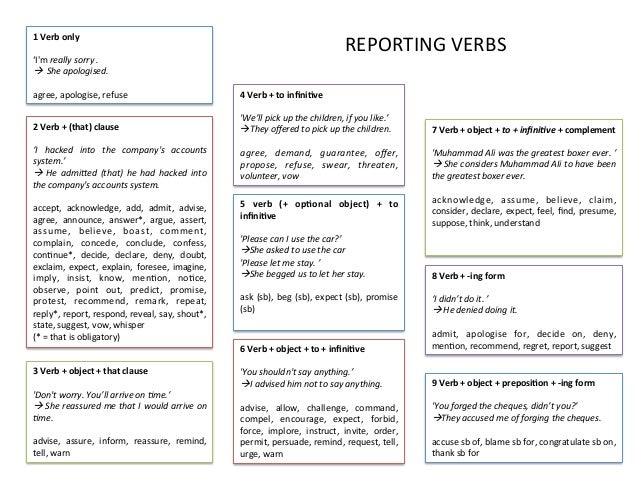
Reporting Verbs Patterns

Friday, 17th March 2017
Lingua e traduzione inglese I
(Monolingue)

Summary slide from: https://image.slidesharecdn.com/


This paragraph describes how the commonest reporting verbs are structured:

to admit (to) doing sth/ + that clause: “ammettere di fare [qlcs]”
Philips openly admits to having an alcohol problem.
Philips openly admits having an alcohol problem.
Philips openly admits that he has an alcohol problem.
to apologise (AmE: apologize) [sb] for doing [sth]: “perdonare [qlcn] di fare [qlcs]”
I apologise my wife for having been unfaithful with me
to deny doing [sth]/ that-clause: “negare di fare [qlcs]”
She denies owing rent money to her greedy roommate.
She denies that she owes rent money to her greedy roommate.
to insist on doing [sth]: “insistere nel fare [qlcs]”
The strikers are insisting on higher wages.
to offer to do [sth] for [sb]: “offrirsi di fare [qlcs] per [qlcn]”
I offer to carry the old lady’s shopping bag for her.
to recommend doing [sth] to [sb]/that [sb] should do [sth]: “consigliare di fare [qlcs] a [qlcn]"
I recommend calling a plumber to you.
I recommend that you should call a plumber.
to refuse to do [sth]: “rifiutarsi di fare [qlcs]”
The child refused to eat his spinach.
to remind [sb] to do [sth]: “ricordare a [qlcn] di fare [qlcs]”
Remind me to call mom at 5pm, please.
to warn [sb] not to do [sth]/ [sb] against doing [sth]/ that-clause: “avvertire [qlcn] di non fare [qlcs]”
I warned him not to get too drunk.
I warned him against getting too drunk.
I warned him that I must not get too drunk.

Grammatical rule

When the gerund has a different subject to the main subject of the sentence, use the object (pronoun) or possessive form:
I insist on him/Mario speaking English in class.
I insist on his/Mario’s speaking English in class.
Instead in the next example the gerund has the same subject as the main verb:
I insist on speaking English in class.
Pay attention to time communication:
I denied stealing the cake.
I denied having stolen the cake.
So: gerund to express past is having + past participle.

Next lesson  

mercoledì 26 aprile 2017

Direct and Reported Speeches and Questions


16th March 2017
Lingua e traduzione inglese I
(Monolingua)

Direct and Reported Speeches

When you transform a direct speech into a reported speech, you must pay attention to:

  • using the backshift,
  • changing pronouns,
  • changing the time expression.
Take a look at the following examples:
DIRECT SPEECH: I'm going to post pictures tomorrow.
REPORTED SPEECH: Regina said (that) she was going to post pictures the next day.
The underlying summary table can help you transform direct speeches into reported speeches:

Risultati immagini per reported speech
From: https://aliciateacher2.wordpress.com/grammar/1271-2/

NB:
In reported questions, the word-order is subject + verb:
DIRECT QUESTION: What time is the next train?
REPORTED QUESTION: She asked what time the next train was.
NB2: In yes/no questions, use if or whether:
DIRECT QUESTION: Do you like watching action movies?
REPORTED QUESTION: She asked if [OR: whether] I like watching action movies.

Vocabulary

English expressions which could give hard time

The following is a list of phrasal verbs and verbal locutions where the native Italian-speaker sometimes make mistakes:

  • to call sth off [= to cancell vtr]: "cancellare, disdire"
  • to get to work (BUT to arrive at work): "arrivare al lavoro"
  • to make up one's mind (ALSO to make one's mind up) [= to decide vtr]: "decidere" 
  • to set off: "mettersi in viaggio"
  • to tell the truth (NOT to say the truth): "dire la verità"
  • to put off; "posporre" = to postpone vtr

Important events

  • bonding n.: "legame"
  • to create a long-lasting relationship: "creare un rapporto duraturo"
  • to have a great time: "spassarsela"
  • on the rocks adv [slang]: "in difficoltà"
  • romantic adj: "romantico" creepy adj: "orrendo, raccapricciante"
  • to spend quality time together: "passare insieme del tempo di qualità"
  • to stand sb up (inf.): "dare buca"

← Previous lesson


martedì 25 aprile 2017

Passive forms for reporting verbs

Lingua e traduzione inglese I
Tuesday, 14th March 2017

Reporting verbs can be expressed in compliance with two different patterns:
  1. it + passive + that clause, e.g.: It's thought (that) restaurants change too much in the town centre
  2. subject + passive + infinitive with to, e.g.: Restaurants are thought to change too much in the town centre.
The following video illustrates clearly the structure and the use of the above-mentioned patterns:

Report

Keeping in mind the patterns I described will help you write a good report texts during B2 examination. But what is a report?
It is a kind of text which presents information about a certain subject.  It usually contains facts about the subject, a description and information on its parts, behaviour and qualities. It is made of:
  • a general opening statement to introduce the subject –a short description or a definition
  • a series of paragraphs, each of which includes one feature of the subject.  Each paragraph begins with a topic sentence 
  • conclusion to summarise the information.
The language must be technical language.
Pay attention: you must avoid evaluative terms and use generalised terms: eg wood, NOT beautiful wood.
The following is an example of a report.

REPORT ON FOOD HABITS IN AREZZO 
Introduction 
The principal purpose of this report is to provide a description of where local people and/or visitors can eat out in Arezzo. During my report, I will focus only on the most remarkable aspects.
The current Situation 
I conducted interviews with an representative statistical sample. The most relevant results are the following:
  • Most of the local people (59%), especially the young, claimed to be particularly fond of all-you-can-eat Sushi-Bars, because they usually offer a good quality-price ratio and an effective service;
  • The majority of the visitors (53%) choose traditional Tuscan restaurants located in the centre, although in most cases they are rather expensive.
Recent trends/Dissatisfaction 
Against this background: the number of Sushi-Bars is rising: it went from 7 (2014) to 11 (2016); the restaurants in the centre are getting more expensive and touristy. 
Recommendations
Taking all the factors mentioned into account, I would recommend: local people should vary further their diet; visitors should look for place where to eat away from the most touristic sites.
NB: Only use the bullet  in one paragraph!

← Previous lesson

giovedì 20 aprile 2017

Modal verbs for speculation

Lingua e traduzione inglese I
Friday, 10 March 2017


The modal verbs for speculation (as well as for deduction) are used in the way which follows:
  • must for certainty (we are sure a fact is true), e.g.: The light’s on. Ken must be at home;
  • can’t/couldn’t for certainty (we are sure a fact is not true), e.g.: Jamie can’t/couldn’t be in the library. It’s closed;
  • may/might/could for possibility (we are less sure), e.g.: The may/might/could be watching us.
In order to revise this type of verbs, you can take a look at the following (really short) video:


The underlying table gives you an overview of modal verbs for speculation tense.

ACTIVE
Present simple
Present continous
Modal verb + base form
Modal verb + be + -ing form
She might post pictures on her blog.
She might be posting pictures on her blog.
Present simple
Past continuous
Modal verb + have + past participle
Modal verb + have been + past participle
I couldn’t have slept well last night.
He could have been working late
PASSIVE
Past simple
Past continuous
Modal verb + be + past participle
Modal verb + have been + past participle
Something should be done.
He may have been delayed by a traffic jam.

Vocabulary

Some words and some locutions (above all about fashion) you should memorise:
  • colours that clash loc. ‘colori che cozzano’
  • disease n. ‘malattia’
  • dreadful adj. ‘orribile’
  • frumpy adj. ‘trasandato’ ↔ fashinable adj. ‘alla moda’
  • porter n. ‘facchino’
  • shopaholic n. ‘maniaco dello shopping’
  • shopaholicism n. ‘mania dello shop’
  • wedge n. ‘zeppa’

Locutions and Synonyms

The underlying notes will be useful for certain transformation words exercises:
  • for a change = in contrast with one’s usual behaviour loc. ‘per una volta’
  • in fashion = popular adj. ‘alla moda’
  • in luck = lucky, fortunate adj. ‘fortunato’
  • in the end = finally adv. ‘alla fine’
  • no longer valid = out of date loc.‘scaduto’
  • on purpose = deliberately adv. ‘di proposito’